Generative AI Private Equity Deal Flow and Value Creation
PE firms embedding AI in portfolio company products are commanding 20x exit multiples.

- Written by
- Dana Ashworth
- Published
- October 16, 2026
- Reading time
- 7 min read
- Sources cited
- 3 sources ↓
What this covers
Private equity is undergoing two simultaneous shifts that reinforce each other: AI has become both a lens for finding and pricing deals and a tool for making acquired companies more valuable. Firms using AI for deal sourcing can identify targets before auction dynamics inflate entry prices, while firms embedding AI into portfolio company products are commanding exit multiples as high as 20x revenue compared to 14x for those using AI only in back-office operations.
According to Accenture's December 2025 analysis, global PE deal value in AI and machine learning more than tripled from 2023 to 2024, and Bain's 2025 Global PE Report found that a large majority of firms now treat AI transformation as a formal value creation lever, up from roughly a third two years prior. Firms that integrate sourcing intelligence, diligence speed, and product-level AI into a single compounding strategy are outperforming those running disconnected pilots, and the performance gap is widening.
AI in PE Is Structural, Not Cyclical
The evidence points to a fundamental repricing of what a business is worth. Investment bankers are telling clients that multiples are falling for software and services companies that do not generate AI intellectual property. The old playbook, where you buy a company, trim costs, and expand margins, no longer produces the premium it once did. Buyers are now shifting diligence from historical financials to data architecture and product roadmaps. That is a new set of rules for how value gets created and measured, not a cyclical adjustment.
AI Is Now PE's Formal Third Lever
The industry has written AI into its playbook as a standalone lever, sitting next to financial engineering and operational improvement. EY's analysis calls AI a "third value lever" in PE, a formal acknowledgment from a major adviser that the framework has changed.
It is no longer enough to buy at the right price and improve how the business runs. Firms must also build, accelerate, or acquire AI capability inside portfolio companies to compete for premium exit multiples. Accenture identifies four shifts that embed intelligence across the deal lifecycle: intelligent origination, AI-augmented diligence, self-optimizing portfolio operations, and talent model transformation. Each one demands skills most firms did not hire for five years ago.
Sourcing Is Now an Intelligence Problem
Agentic AI scans filings, sentiment, and sector activity independently, surfacing hidden targets before the market reacts. The competitive question is whether a firm can act on a signal faster than its competitors.
The infrastructure around this is consolidating quickly. Datasite acquired Grata, then SourceScrub in August 2025, folding human-verified data into an AI-native market intelligence platform, and closed BlueFlame AI on July 23, 2025, adding an agentic deal workspace on top of its Diligence virtual data room. One vendor now owns sourcing, the workspace, and the VDR for a meaningful share of PE deal flow. Rogo raised $160 million at a $2 billion valuation in April 2026, three months after a $75 million Series C at $750 million, and now counts more than 35,000 professionals across over 250 financial institutions among its users. Affinity added 71 new PE firms in the six months before mid-2026, bringing its customer count past 330, as mid-market funds standardize on relationship intelligence rather than tracking activity in spreadsheets.
A majority of practitioners in one survey call AI ineffective for deal sourcing, and the average firm still sees only a fraction of relevant deals. The advantage goes to firms that resolved their data quality problems before deploying AI, not to the majority still running pilots.
AI Diligence Changes Underwriting Risk Profiles
AI can compress diligence timelines significantly, with PwC estimating meaningful productivity gains on document review, financial analysis, and ESG data aggregation. The gain only appears, however, if the data feeding the models is clean. Structured data is required for analytical models and unstructured data for generative ones, and fixing quality problems costs money and time. Firms must pick which data domains matter most rather than trying to clean everything at once.
Keye launched Odin in January 2026, positioning it as a deterministic diligence co-pilot rather than a purely generative one, on the premise that speed without audit-ready rigor is useless in a quality-of-earnings setting. Hebbia's Matrix and Rogo's Felix cross-reference CIMs, filings, and expert call transcripts for adjacent workflows. The common thread is that AI must produce outputs a human can defend. Accenture sees the endpoint as diligence moving from a static snapshot to a living model, where agentic systems continuously ingest financial, operational, and ESG data and simulate synergy confidence ranges on an ongoing basis.
Portfolio AI Adoption Lags GP Ambition
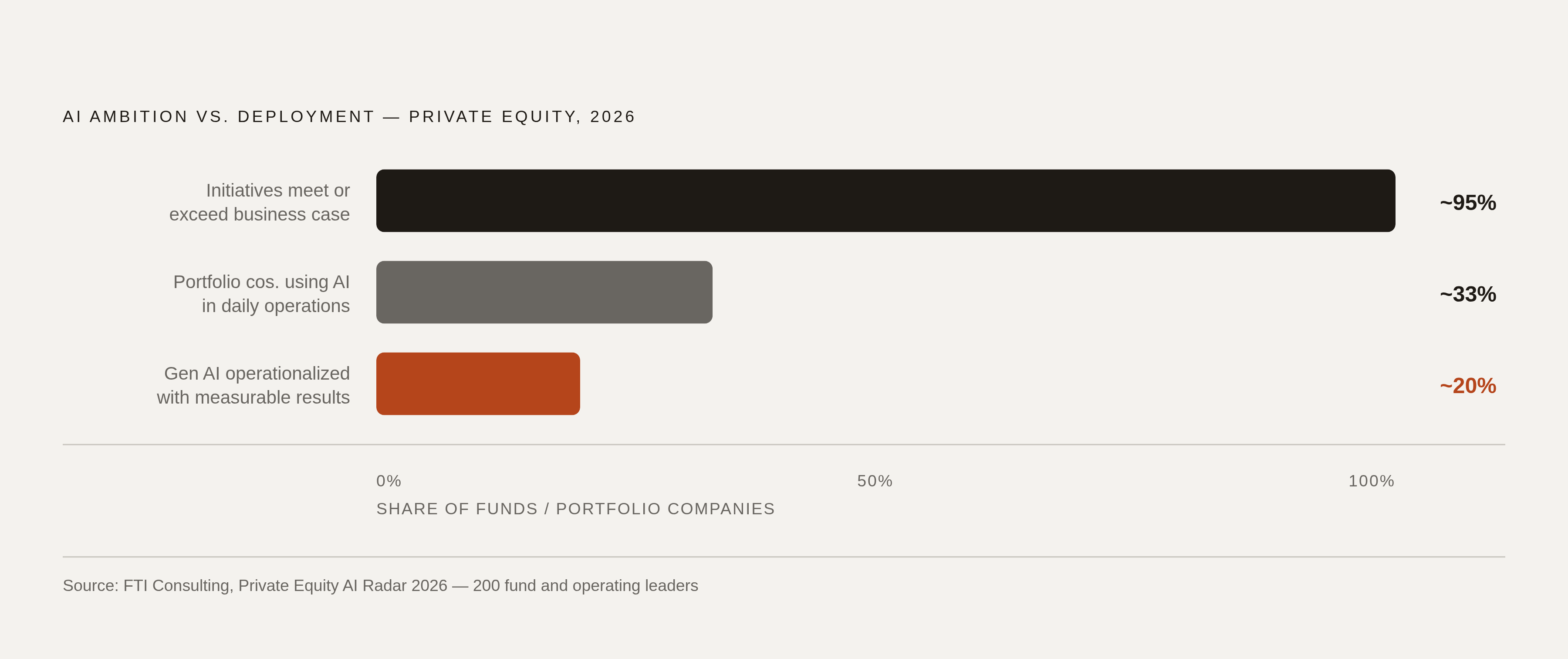
FTI Consulting's 2026 Private Equity AI Radar surveyed 200 fund and operating leaders and found that nearly all funds reported their AI initiatives meet or exceed the business case, yet only about a third said portfolio companies actually use AI in day-to-day operations, and a very small share described it as fully integrated across the portfolio. Only about one in five portfolio companies has operationalized generative AI with measurable results. Most general partners expect high impact, but not for three to five years.
When returns do exist, they skew toward cost savings rather than revenue growth. That matters because the premium multiple narrative requires AI in the product, not just in the back office. Reducing customer service costs is an operational gain that will not drive a 20x exit.
Accenture's execution framework recommends picking two or three high-value domains, building the data and architecture foundation first, tying each AI agent to a measurable outcome such as EBIT uplift or cycle-time reduction, and defining human-in-the-loop thresholds before scaling. One North American financial institution followed that sequence: consolidate data centers, modernize the architecture, migrate to cloud, then introduce agents. The foundation must come before any advanced deployment.
Product-Embedded AI Commands the Exit Premium
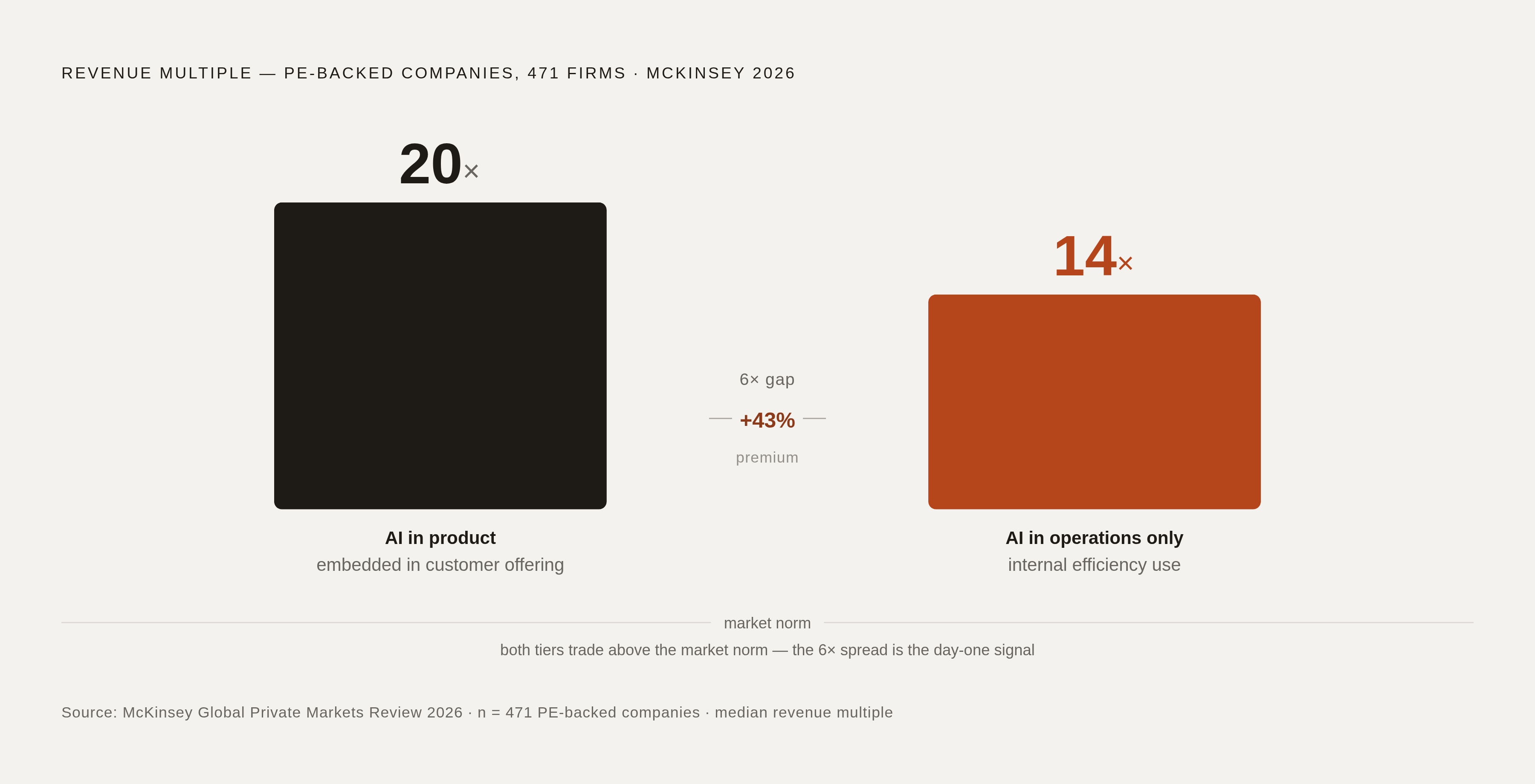
The exit premium for AI concentrates in companies that put AI into their products rather than only their internal operations, creating a two-tier exit market with a spread wide enough to change how you underwrite a deal. McKinsey sorted 471 PE-backed companies by level of AI use in its 2026 analysis and found that companies embedding AI in their products traded at a median revenue multiple of 20x, while companies using AI only inside their operating model traded at 14x. Both exceed the market norm, but the product layer is where the meaningful exit economics live.
The implication for general partners is that value creation work must begin at acquisition. A firm cannot retrofit AI into a product roadmap in the final year before exit and expect the multiple to move. Accenture's leadership confidence data found that PE professionals' confidence in customer segmentation and targeting rose measurably from 2023 to 2025, reflecting a real shift toward identifying customers with greater precision rather than simply cutting costs.
Sourcing and Value Creation Compound Each Other
Firms that use AI to source better deals and build AI into the companies they buy are compounding the same capability twice, and the effect appears in the length of time they hold assets.
AI sourcing finds targets before auction dynamics inflate the entry price. AI diligence shortens the pre-close window. AI embedded in portfolio operations accelerates the revenue growth and product differentiation that drive premium multiples. The firm exits faster, at a higher multiple, and redeploys capital into the next cycle. Accenture's data show PE transaction value by Q3 2025 had already matched the prior full year's total while deal volumes fell, meaning execution-ready theses now beat raw volume.
EY data show a large majority of US PE firms have appointed a Chief AI Officer, and a similarly large share have committed more than $1 million to generative AI. Firms that treat sourcing AI and portfolio AI as separate workstreams with no shared data layer and no common metrics will have a collection of initiatives rather than a compounding strategy.
Valuation Gaps and Execution Risks Are Structural
The thesis has three compounding risks that are structural features of this environment rather than temporary wobbles. Disciplined firms can manage them. Firms chasing the narrative without the operational foundation will find them existential.
The valuation modeling problem receives the least attention. It has been just over three and a half years since ChatGPT launched, which means the minimum PE hold period now spans the entire generative AI era. No exit multiple modeled before 2022 is reliable, and today's models have no historical analog to validate against. Funds that loaded up on enterprise software are already living with this reality: EV/Revenue multiples sit at multi-year lows after steep compression from the 2021 peak, and every AI-related deal underwritten in this cycle carries that uncertainty.
The funding market carries its own fragility. Allianz's AI Bubble Risk Monitor still signals moderate bubble pressures, and widening credit spreads mean the market is more sensitive to execution risk on both capital expenditure discipline and revenue realization. With mark-to-market accounting, hyperscalers book unrealized gains on equity stakes as net income, making fiscal demand appear healthier than it may be. The concentration problem compounds this: the record Q1 2026 generative AI funding figure was dominated by two megadeals that accounted for nearly all of the total, so the aggregate number misleads any general partner evaluating mid-market AI targets.
The execution gap ties the other risks together. The same data that show overwhelming GP intent also show thin portfolio-level deployment. A large share of the AI valuation premium being paid at entry is purchased on the basis of a plan rather than a proof. For limited partners, this is now a diligence question, not an assumption. The answer for firms that intend to run this strategy more than once is straightforward: prioritize data quality before AI deployment, tie measurable outcomes to each agent, maintain governed autonomy, and build hold period models that do not assume 2021-era exit multiples will return.
Methodology & sources
- Agentic AI Is Redefining Private Equity in 2026
Provided the four-shift framework (intelligent origination, AI-augmented diligence, self-optimizing portfolio operations, talent model transformation), the execution sequencing recommendations, PE transaction value data through Q3 2025, and leadership confidence figures on customer segmentation.
- How Private Equity Firms Are Creating Value with AI
Supported the framing of AI as a formal third value creation lever in private equity alongside financial engineering and operational improvement.
- Private Equity: Value Creation in Portfolio Companies
Informed the discussion of AI transformation as a formal value creation lever adopted by a large majority of PE firms, up from roughly a third two years prior.