Nontraditional Investor Influence on Startup Round Dynamics
Corporate venture arms and sovereign wealth funds are reshaping startup valuations and control.

- Written by
- Elise Beck
- Published
- October 31, 2026
- Reading time
- 8 min read
What this covers
- Why the VC market's bifurcation made nontraditional capital structurally necessary, not optional
- How corporate venture arms changed what a startup round is for
- What sovereign wealth funds bring to a round that no other capital source replicates
- How crossover funds distort valuation and what their retreat left behind
Startup rounds are no longer shaped mainly by how much money investors offer. Corporate venture arms, sovereign wealth funds, crossover funds, and hyperscale cloud providers bring different reasons for investing, and those reasons change pricing, terms, and control. A founder who negotiates the valuation without understanding the investor’s incentives has read only the price tag.
Why the VC market's bifurcation made nontraditional capital structurally necessary, not optional
Fewer rounds absorbed more money. That split describes a market where check size, rather than deal count, increasingly defines the upper tier. Later-stage funding takes a growing share of the money, while the middle market struggles to raise it.
AI’s compute requirements help explain why this is structural. Traditional VC fund economics cannot support the largest capital requirements alone, and the category-winner dynamic concentrates investment in a small group of consensus bets. Nontraditional investors fill that gap because they have the money and the mandates to invest at that scale. Once they become the primary capital formation mechanism for the most strategically important companies, their structural preferences become the market’s structural preferences.
How corporate venture arms changed what a startup round is for
Corporate investors now participate in roughly one in every five startup funding rounds, and more than half of startup investment dollars flow through rounds with a corporate backer. Participation means corporate interests are present in the negotiations through which much of the market’s capital moves, whether or not they provide every dollar. A round that includes a customer, supplier, or potential competitor has a different incentive map from one built entirely around financial returns.
Those interests also arrive earlier than they once did. More corporate venture deals than ever are early-stage as a share of the total, though most corporate dollars still go into large rounds. Before this cycle, corporate venture capital was predominantly a late-stage phenomenon. Now it can influence company formation itself. A corporate investor can now support expansion and shape what gets built from the first institutional check through its strategic agenda.
Nvidia participated in more than 80 startup funding rounds in 2025, with a cumulative round value running into the tens of billions. Here, the investor is also the infrastructure supplier. Its presence tells other investors that a company can compete, while the heavy flow of corporate capital into AI helps decide which companies become consensus bets. Sanofi’s substantial expansion of its venture arm shows the same strategic logic outside tech. Corporate investment can serve as a way to spot developments and preserve future options, rather than solely maximize returns, so alignment today does not settle the question of alignment at the next financing.
What sovereign wealth funds bring to a round that no other capital source replicates
Sovereign wealth funds invest on a different axis. Their combination of scale, legitimacy, geopolitical patience, and national mandate is not something a private investor can reproduce simply by offering a higher valuation. GIC co-led Anthropic’s landmark February 2026 round with Coatue, placing sovereign capital at the center of the financing. Backing at that scale helps decide which companies can stay private while raising huge sums.
That capacity comes with a different clock. Sovereign funds align private-market investments with long-term national priorities rather than merely reacting to short-term market conditions. Their exit timelines and return expectations can therefore differ fundamentally from a traditional VC fund’s seven-to-ten-year horizon. Patience gives a company room, but it is not indifference. A national mandate can shape what an investor considers a successful outcome, just as a corporate strategy can, without being reducible to the same customer or supplier relationship.
The IE University Sovereign Wealth Funds Report 2026 describes declining concentration as newer entrants, including UAE’s MGX and Norway’s GPFG, expand activity. MGX is sovereign-backed rather than a conventional sovereign wealth fund, a distinction that keeps the category from looking more uniform than it is. The top five funds still account for a large share of deal value, but participation is broadening. Ramp and another company also illustrate sovereign involvement beyond landmark megadeals. For a syndicate, the implication is a wider set of potential anchors whose patience comes from distinct institutional commitments.
How crossover funds distort valuation and what their retreat left behind
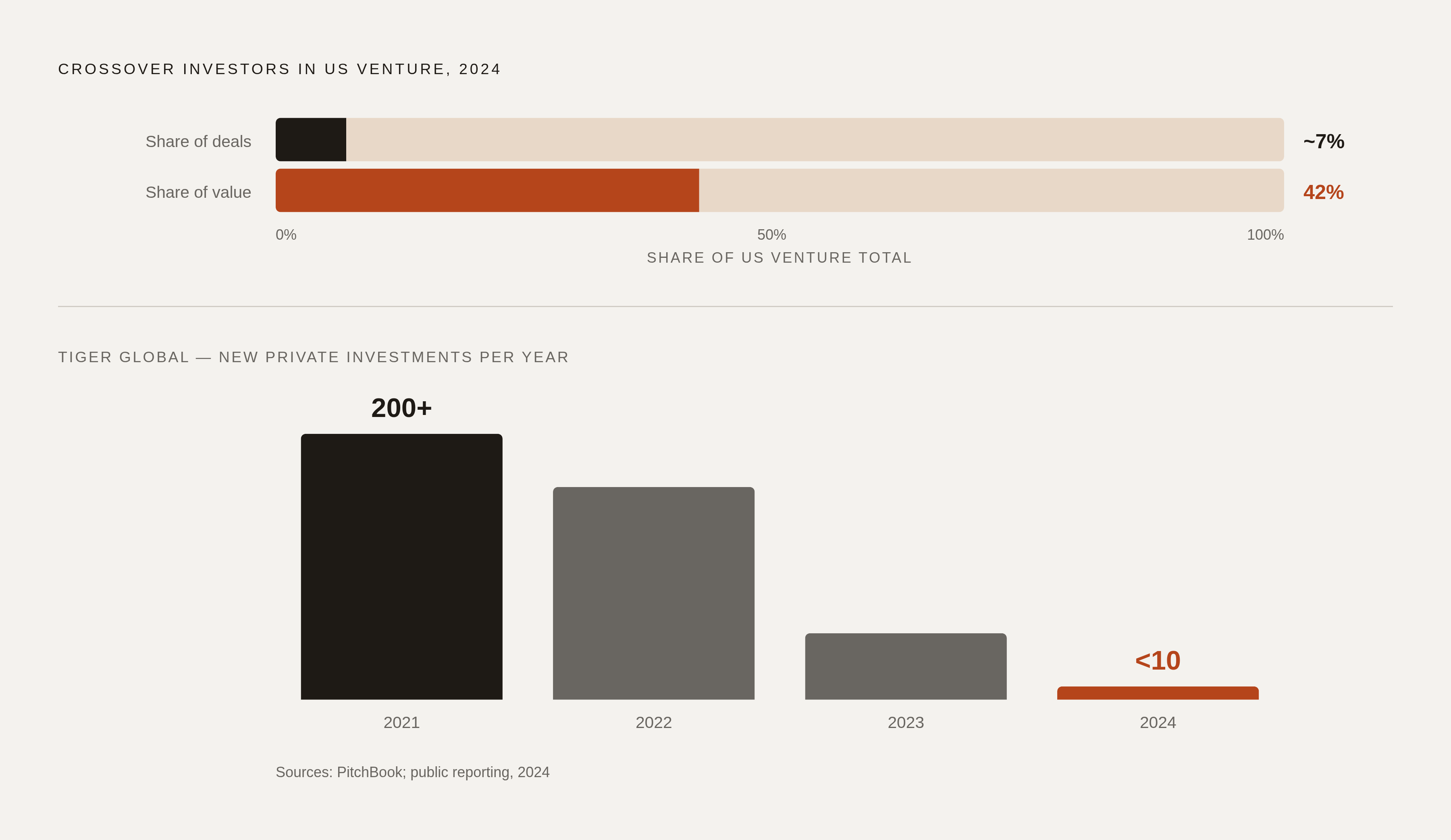
The PitchBook-NVCA Venture Monitor found that crossover investors participated in a small fraction of US venture deals in 2024 but accounted for roughly 42% of total deal value. Their influence exceeds their deal count. Because they focus on large deals, the prices they help set can shape what investors expect elsewhere. When speed and plentiful capital dominate the negotiation, a funding event becomes a valuation event for more than the company receiving the check.
Tiger Global’s trajectory shows how quickly that logic can reverse. It went from leading more than 200 startup rounds in 2021 to fewer than ten new private investments in 2024, while its latest fund closed at a fraction of the vehicle raised in 2022. During the boom, its hands-off approach rarely involved board seats and prioritized speed over diligence. Valuations rose, but oversight did not rise with them. Companies that needed one round after another to stay afloat were stranded when crossover investors pulled back.
In 2026, Tiger is concentrating on AI infrastructure and application-layer leaders, later-stage growth rounds, and discounted secondaries. The playbook is more selective and structurally protected. Anthropic’s recent syndicates show another change, with Coatue, D1 Capital Partners, D.E. Shaw Ventures, Appaloosa, and Whale Rock Capital Management participating with sovereign and corporate capital. Traditional VCs and founders also gained from the liquidity, and the deeper failure was the lack of governance that could question rising valuations before the funding stopped.
The term sheet consequences of syndicates built around nontraditional lead investors
Structured deals separate the advertised valuation from the economics underneath it. A company can raise at a headline valuation that looks flat or higher while granting downside protection that makes the effective valuation significantly lower. The paper number survives. The bargain changes. That gap becomes most consequential when another financing or an exit tests what each investor is entitled to receive.
Senior liquidation preferences and IPO ratchets make that distinction concrete. International lead investors are more likely to seek senior liquidation preferences, which put their claims ahead of others when proceeds are distributed. An IPO ratchet protects an investor if a public offering is priced below the level they agreed on. These clauses reflect investors’ willingness to accept a visible valuation only if the contract limits their exposure to a less favorable outcome.
The return of those protections also changes what an apparent vote of confidence means. IPO ratchets were nearly absent in 2021 but reappeared in a meaningful share of later-stage term sheets in 2025. A high price with protection is not the same commitment as a high price without it. For founders, the practical question is how the negotiated protection changes the next financing or exit, rather than whether the announcement can avoid the phrase “down round.” The press release is not on the distribution schedule.
Family offices entering as junior co-investors increasingly rely on sovereign and sponsor due diligence instead of conducting their own, with “paying lower fees” cited as a benefit. More names do not necessarily mean more scrutiny. Governance capacity concentrates in the lead that performed the diligence, while other investors depend on its assessment. The resulting mismatch is between the apparent breadth of support and the much narrower group equipped to question the company’s direction.
How megaround normalization changed the governance bargain for founders
A large majority of 2026’s VC funding has gone to billion-dollar-plus rounds, whereas such deals were a minority before 2026. Their governance arrangements are no longer an edge case. For the most strategically important companies, they increasingly define the standard bargain between capital and control. Accountability is redistributed among investors who want different things from the same business.
Sovereign funds and family offices often deprioritize board involvement, framing patient capital and strategic alignment as alternatives to hands-on oversight. In some sovereign direct investments, investors take board seats and an active role in governance. Where investors do remain passive, founders who prefer control can willingly accept the trade. Less intervention can support speed and scale, but it does not provide the adversarial pressure that an engaged board brings to difficult decisions.
Traditional VCs argue that the last cycle showed the cost of taking money from investors who neither sit on the board nor answer for how the company is run. In a mixed syndicate such as Anthropic’s, sovereign anchors, crossover funds, corporate strategics, and traditional VCs bring different time horizons and return requirements. One investor may have the power to act while another has the reason to push back.
That split changes the value of a traditional VC’s board seat. The seat may confer a formal role without settling who can influence pricing or exercise effective veto authority when sovereign or corporate investors can independently supply follow-on capital. A chair at the table is not the table. The governance bargain therefore concerns the relationship between decision rights and financing power. The effects of that bargain may stay hidden until the next financing brings those interests into conflict.
What founders and traditional VCs can do with this understanding when structuring a round
For founders evaluating a nontraditional lead, the useful starting point is a sharper set of questions rather than a blanket preference for or against the category. What does the investor contribute through cloud credits, distribution, regulatory access, or customer relationships, and what governance capacity comes with that contribution? What exit timeline follows from its fund structure? Those questions belong in the same conversation. Strategic benefits and a generous price do not answer whether the investor can support the company through later changes in direction.
Corporate seed and Series A capital makes that assessment especially important because strategic interests now enter at formation. Does the backer’s agenda remain aligned through the full financing arc, or only through the current round? Early alignment is not a lifetime warranty. The governance gap is also most acute at this stage, when board oversight and founder coaching have the highest marginal value. By the time sovereign and crossover capital arrives, much of the company’s strategic direction is already set.
For traditional VCs, the corresponding question is whether the syndicate gives board governance teeth. A seat with five passive co-investors is structurally different from a seat with one active co-lead, even if both arrangements look well funded. Who has done the diligence, who will challenge decisions, and who can finance the company without the others? Redbud VC enters this discussion as a partner for founders navigating those choices. The useful work is to connect investor incentives with terms and governance, rather than treat a prestigious cap table as a substitute for that analysis.
These investor categories are not converging on one model. Corporate strategy, national priorities, and crossover return requirements will keep applying different pressures to startup rounds. The founder or traditional VC who maps the incentive before signing the term sheet retains more room to maneuver when those pressures diverge.